
Complex mathematics with real-world applications.
An exploration of quantitative finance through CAPM, Principal Component Analysis, and the Black-Scholes-Merton options pricing model—from retail investment fundamentals to stochastic calculus and free boundary problems.

Understanding risk-return relationships in markets.
The CAPM provides a framework for understanding the relationship between systematic risk and expected return. It forms the foundation for modern portfolio theory and quantitative risk management.
- Expected return via alpha and beta coefficients
- Systematic vs unsystematic risk decomposition
- Security market line and market equilibrium
- Portfolio optimization and efficient frontier
Dimensionality reduction for portfolio analysis.
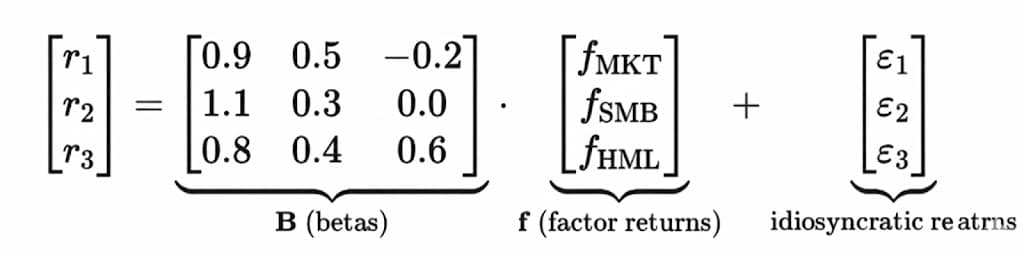
PCA uses eigendecomposition and linear transformations to reduce complexity in financial datasets. By ordering eigenvalues, we identify the principal components that explain the most variance.
- Linear transformations on portfolio matrices
- Eigendecomposition for component identification
- Variance explained by each component
- Feature extraction in financial datasets
Options pricing through stochastic calculus.
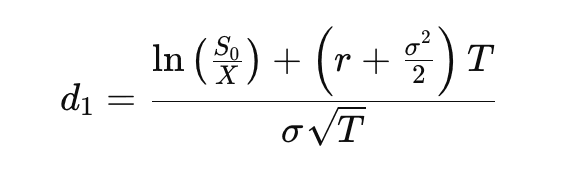
The Black-Scholes-Merton model revolutionized derivatives pricing by providing a closed-form solution for European options. It models stock prices as geometric Brownian motion and derives pricing through risk-neutral valuation.
Key assumptions include constant volatility, continuous trading, and no dividends. The model uses the cumulative normal distribution for probability calculations.
American options with early exercise rights.
American options introduce early exercise rights, creating a moving boundary between optimal hold and exercise regions. This transforms the pricing problem into a free boundary PDE with complementarity conditions.
- Moving boundary between hold/exercise regions
- PDE with complementarity conditions
- No closed-form solution exists
- Requires numerical methods to solve
Computational approaches to complex models.
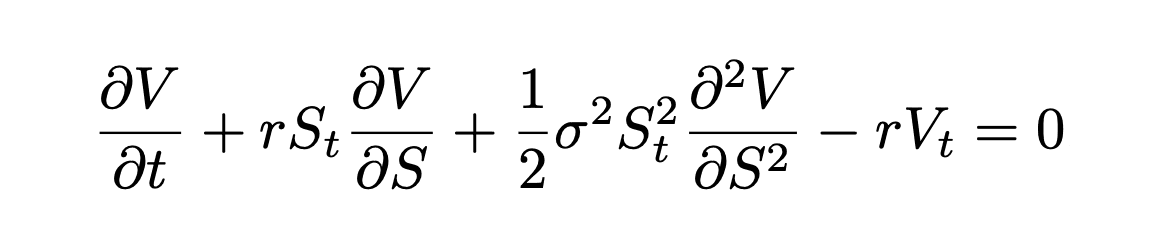
When analytical solutions don't exist, numerical methods provide the path forward. Finite difference methods discretize the Black-Scholes PDE, while Monte Carlo simulation leverages the law of large numbers for option pricing.
- Finite difference methods for PDE solving
- Itô calculus for stochastic differential equations
- Monte Carlo simulation for option pricing
- Binomial tree models for American options
- Numerical optimization algorithms